
30-Year Recertification Miami, Florida
Miami wrote the playbook on building recertification long before it became state law. If your property is approaching the 30-year mark — or the accelerated 25-year coastal deadline — Souffront’s licensed engineers guide Miami-Dade owners and associations through the entire process.
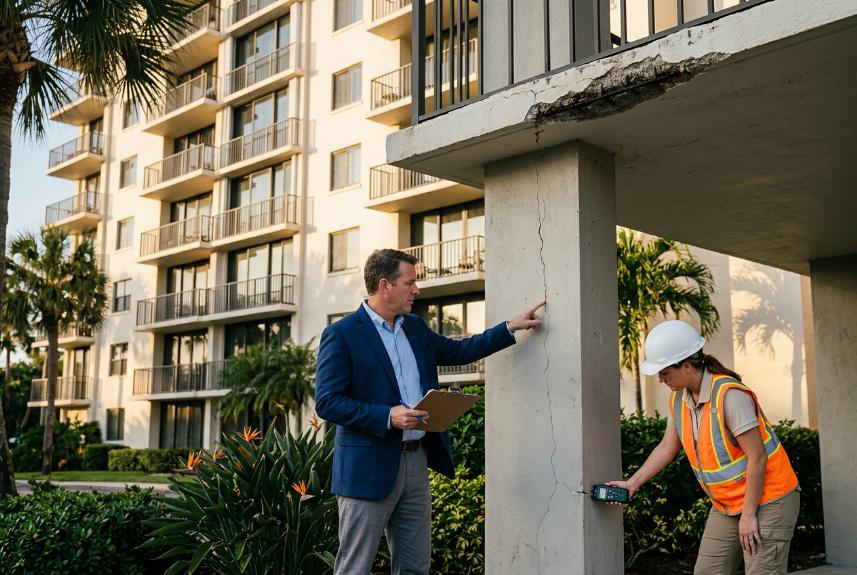
40 Years in Florida
2,478+ Projects Completed
5,454 Inspections Performed
Licensed PE & GC
Why Miami-Dade Leads Florida's Recertification Standard
Long before Tallahassee passed statewide legislation, Miami-Dade and Broward Counties already required aging buildings to prove their structural soundness — a local ordinance that predates the current 30-year law by decades. That history is why Miami property owners are often more familiar with recertification than owners elsewhere in the state, and why local building departments move efficiently through the review process.
Today’s rule is straightforward: buildings reach a mandatory inspection milestone at 30 years, or at 25 years if the property sits within three miles of the coast — a threshold that captures the overwhelming majority of Miami’s high-rise and mid-rise inventory. Every 10 years after the first inspection, the cycle repeats.
This matters more in Miami than almost anywhere else in Florida. The combination of salt air, high humidity, and dense concrete high-rise construction means structural wear accelerates faster here than in inland cities. A building that might show minimal deterioration after 30 years in Orlando could show significant spalling or rebar corrosion in the same timeframe along Biscayne Bay or Miami Beach. That’s precisely why the accelerated coastal threshold exists — and why an engineering firm with genuine South Florida experience matters when your building’s compliance timeline is on the line.
- Zone
- Within 3 miles of coastline (most of Miami)
- Inland Miami-Dade properties
- Buildings already under the 40-Year Program
- First Inspection Due
- Age 25
- Age 30
- Current cycle continues
- Repeats Every
- 10 years
- 10 years
- 10 years
Structural and Electrical Systems Under Review
Miami-Dade’s recertification standard examines two core systems, and in coastal buildings, the salt-air exposure makes both more urgent than in inland Florida markets.
Structural Elements
Electrical Systems
Main service panels, distribution wiring, and grounding are evaluated by a licensed electrical engineer for code compliance and fire safety.
Balcony & Façade Condition
Seawalls & Waterfront Structures
Properties along Biscayne Bay or canal-front lots may need adjacent seawall inspection alongside the standard recertification scope.
From Notice to Certification: What to Expect
County Notice Arrives
Miami-Dade's building department mails official notification once your property reaches the applicable age threshold — owners have 90 days to submit a completed report.
Phase One Visual Survey
Our engineers walk the entire property — habitable units, common areas, mechanical rooms, and garage levels — documenting condition and flagging any areas of concern.
Phase Two, If Warranted
Spalling, cracking, or corrosion discovered in Phase One triggers deeper testing — core sampling, load analysis, and other diagnostic methods to quantify the extent of deterioration.
Sealed Report Delivered
Souffront submits a signed and sealed engineering report directly formatted for Miami-Dade's building department review process.
Repairs, If Required
Where the report identifies deficiencies, our project oversight team can manage remediation directly — from concrete restoration to electrical upgrades — without restarting the bidding process.

Miami-Dade Neighborhoods We Serve
From beachfront condo towers to inland commercial buildings, Souffront’s recertification team covers Miami-Dade County end to end. Whether your property sits on a barrier island facing direct salt exposure or further inland where deterioration progresses more slowly, our engineers adjust the inspection approach to match the building’s actual environmental exposure — not a one-size-fits-all checklist.
Downtown Miami
Brickell
Miami Beach
Coral Gables
Coconut Grove
Aventura
Sunny Isles Beach
Kendall
Doral
Hialeah
A Licensed Firm That Knows Miami-Dade's Process
Our reports are structured to match what Miami-Dade’s building department expects — reducing back-and-forth and processing delays.
As a licensed GC, Souffront can move directly from inspection findings into remediation work without a separate contractor search.
Four decades of Florida experience means we know exactly where salt-air damage typically concentrates in Miami-Dade’s building stock.
Many Miami buildings need both a recertification and a milestone inspection — we coordinate both under a single engagement.
You’ll know your inspection date, report delivery window, and next steps up front — no chasing status updates.
Miami-Dade’s building department processes thousands of recertification submissions every year, and the county’s review standards are exacting. Reports that are incomplete, improperly formatted, or missing required documentation get bounced back — costing owners weeks of additional delay on an already tight 90-day window. Souffront’s familiarity with the county’s exact submission requirements means fewer resubmissions and a faster path to compliance.
Trusted by Companies and Homeowners Associations













Miami Recertification — Common Questions
When did Miami-Dade first require building recertification?
Miami-Dade pioneered the concept decades ago, long before it became a statewide mandate. The county’s early adoption is precisely why the 25-year coastal threshold and 40-year program both trace their origins here.
Is the 30-year or 25-year rule the one that applies in Miami?
Most of Miami and Miami-Dade County sits within the 3-mile coastal zone, which triggers the accelerated 25-year deadline rather than the statewide 30-year standard. Souffront verifies the exact threshold for your building’s address before scheduling.
Who can legally sign off on a Miami recertification report?
A Florida-licensed structural engineer or architect must inspect and seal the report. Buildings four stories or taller, or those meeting the threshold building definition, additionally require a licensed electrical engineer to evaluate electrical systems.
What triggers a Phase Two inspection in Miami-Dade?
If the Phase One visual survey uncovers spalling, cracking, corrosion, or other signs of significant structural deterioration, the county requires a more invasive Phase Two evaluation involving destructive and non-destructive testing to quantify the damage.
What's the penalty for a Miami building that skips recertification?
Non-compliant buildings face code enforcement fines that accrue daily, and HOA or condo board members risk personal liability exposure for failing their fiduciary duty. Miami-Dade building officials can also flag the property, complicating future sales or refinancing.
Which Miami-Dade properties don't need to recertify?
Single-family homes, duplexes, and small structures under roughly 2,000 square feet with fewer than 10 occupants are generally exempt. Condominiums, commercial buildings, and multi-family properties over the age threshold are not exempt.


Souffront manages the inspection, the sealed report, and any required repairs — one licensed firm, start to finish.